 HeySolids
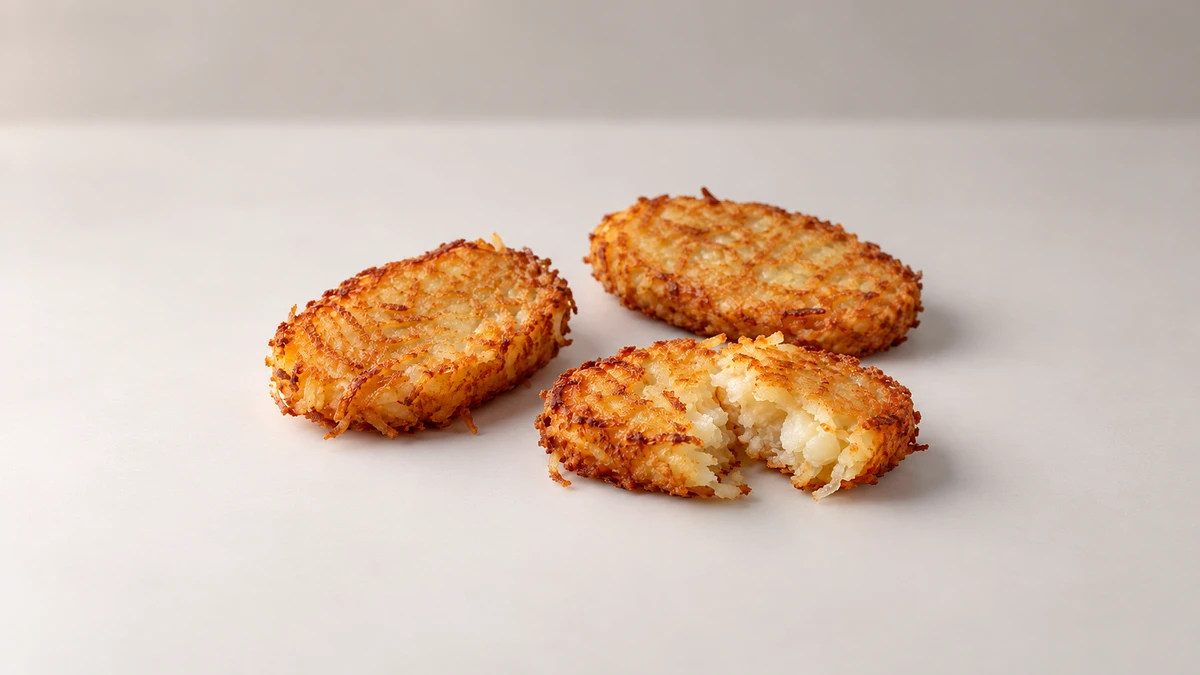
Can babies have hash browns?
Yes, from around 6 months, if you make them yourself. Grate a potato, skip the salt, add a few drops of oil, and bake it as a thin patty until it’s pale gold and presses easily between two fingers. Made this way, a hash brown is just potato, with its potassium and vitamin B6.[1]
Diner hash browns and frozen patties are a different food. A single fast-food hash brown has about 300 mg of sodium, most of a baby’s 370 mg daily guide at 7 to 12 months, plus around 9 g of fat. Frozen ones are salted too, and often contain corn or wheat flour.[2][3]
Save these for after 12 months, and then only as an occasional treat. Offer a small piece, broken up, and set aside the crisp edges. Keep homemade baked patties as the everyday version.
Choking risk
Hash browns are a moderate choking risk - not because of the potato, which is soft, but because a fried patty grows a crisp shell and dry shreds that snap into hard crumbs, close cousins of the potato chips the CDC lists as a hazard.
Bake a homemade patty until it squashes easily between two fingers and is only pale gold, then cut it into finger-length strips; a diner hash brown waits until 12 months, and even then only the soft center. See how to serve for age-by-age prep.
Allergens
Hash browns are not a common food allergen, and a true allergy to potato is rare; it has mostly been described in babies and young children who already have eczema or other allergies.[6][7]
The extras are what to read for: some frozen patties list a natural flavor made with wheat and milk, and others use wheat flour as a binder.[2] Restaurant hash browns can carry wheat and milk in the flavoring too, so check the chain's allergen list.[8] A plain homemade patty is just potato and oil.
Start with a small amount and watch for a reaction.
If baby refuses
A patty cooked too long turns tough and crumbly for new gums, so refusal is usually about texture. Serve it warm and softer than you'd make for yourself, tear it smaller, or stir a few shreds into mash or scrambled egg. If it's still pushed away, bring it back another day.
Food safety
Salt is the main reason to keep hash browns homemade in the first year. The CDC advises avoiding salty foods for young children, and frozen patties range from under 200 mg to nearly 400 mg of sodium each.[4][2]
Browning is the second reason. Frying produces more acrylamide than roasting or baking, and the brown parts hold the most, so the FDA advises cooking potatoes to golden yellow rather than brown. Soaking the grated potato in water for 15 to 30 minutes before cooking helps, and so does storing potatoes outside the fridge.[5]
How to serve
6+ months old
Soft unsalted homemade patty cut into a strip
A strip about the length of an adult finger
Cut one soft, unsalted patty into a strip about the length of an adult finger, so your baby can hold it in a fist with one end poking out. Or crumble a little into a spoonful of mash. The patty should press easily between two fingers; if it crunches, it’s cooked too long.
How to cook
Grate a peeled potato, soak the shreds in cold water for 15 to 30 minutes, then squeeze them dry in a clean towel. Toss with a few drops of oil, press into a thin patty on a baking sheet lined with parchment, and bake in a hot oven until soft all the way through and pale gold on top, not brown. Let it cool before serving.
9+ months old
Small soft pieces torn from a homemade patty
About 1/2 inch
Tear the same soft patty into pieces about 1/2 inch across for pincer-grasp practice, and keep a strip alongside for a baby who can't pick up small bits yet. Still no salt: grated onion squeezed dry, a pinch of paprika or some chopped herbs are the way to add flavor.
How to cook
Bake as at 6 months, soft right through and barely golden, then tear rather than slice so the edges stay tender. A little olive oil or melted butter brushed on the shreds adds richness, and a spoonful of mashed sweet potato or grated zucchini mixed in keeps the patty moist.
12+ months old
A small share of family hash browns, occasionally
A few broken-up pieces, crisp edges removed
From 12 months, a small share of ordinary hash browns can be part of a weekend breakfast now and then. A fast-food hash brown has about 300 mg of sodium, and the daily guide at 1 to 3 years is 800 mg. Give your toddler a few broken-up pieces from the soft middle, and keep the crisp edges for the adults, since they break into hard, chip-like shards.
How to serve
Frozen patties vary a lot in sodium, so compare labels and pick the lowest. Split one baked patty between your toddler and an adult. Homemade with no salt is still the everyday version, baked as before and taken out at golden rather than brown.
Tips
- Squeeze the shreds dry. Soaked shreds need draining and blotting dry before cooking, or they spatter in hot oil.[5] Dry shreds bake into a patty that holds together, and pulling it at pale gold keeps the middle soft.
- Buy plain frozen shreds, not patties. A bag whose ingredient line is just potatoes has no added salt; the formed patties are made with salt and oil.[2]
- Treat a strip as a carrier. A soft hash brown strip holds a smear of mashed avocado, thin nut butter or a little grated cheese, and the shreds take garlic powder or paprika instead of salt.
Sources
- Potatoes, hash brown, home-prepared (FDC 170036) - USDA FoodData Central
- Hash brown patties, fast food (FDC 173273) and frozen branded patties (FDC 2597170, 2409669, 2661004) - USDA FoodData Central
- Dietary Reference Intakes for Sodium and Potassium (AI 370 mg at 7-12 months, 800 mg at 1-3 years) - National Academies 2019
- Foods and Drinks to Avoid or Limit (honey, added sugar, salt) - CDC
- Acrylamide and Diet, Food Storage, and Food Preparation (fry to golden yellow, soak potatoes 15-30 minutes) - FDA
- Food Allergies (the 9 major US allergens) - FDA
- Allergy to cooked white potatoes in infants and young children - J Allergy Clin Immunol 2002 (PubMed 12209106)
- Hash Browns ingredients and allergens (Natural Beef Flavor with hydrolyzed wheat and milk; Contains: Wheat, Milk) - McDonald's US
- Choking Hazards (Infant & Toddler Nutrition) - CDC