 HeySolids
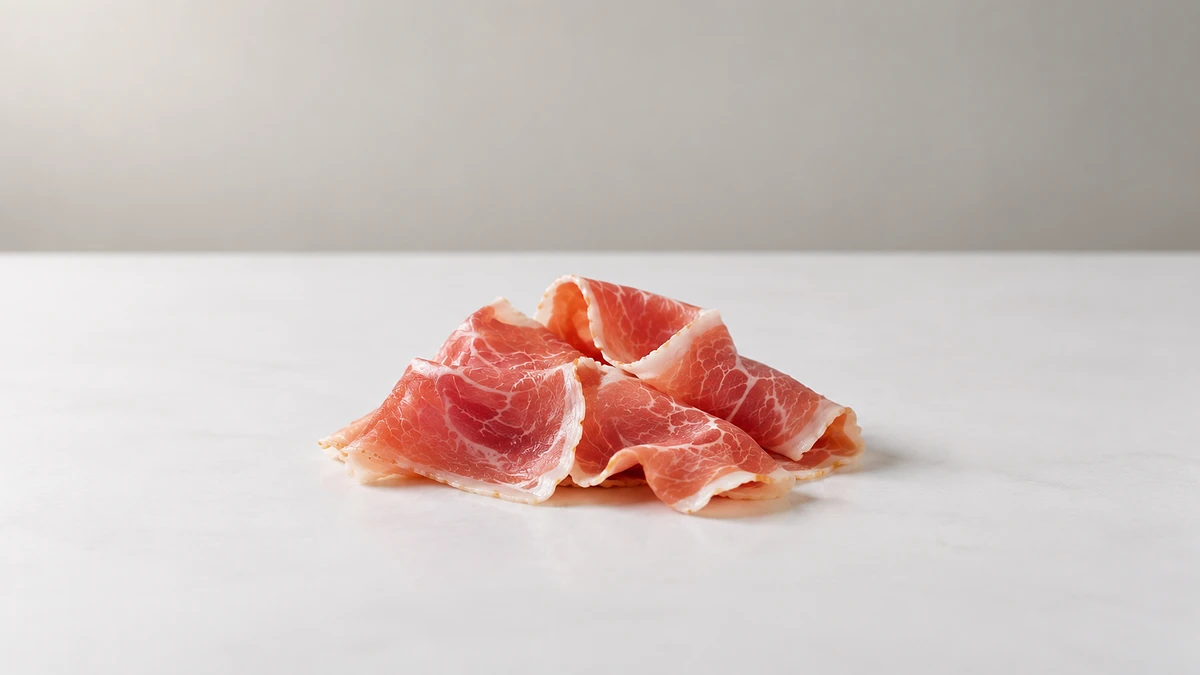
Can babies have prosciutto?
Not before 12 months, and after that only as a seasoning, not as a serving of meat. Prosciutto is raw pork leg that’s made safe to eat by salting and months of aging rather than by cooking, and the USDA notes that dry curing makes a very salty product.[1]
USDA data lists about 2,700 mg of sodium per 100 g, so 1 oz (often two slices) has up to about 750 mg. That’s double a baby’s 370 mg daily guide at 7 to 12 months, and most of the 800 mg guide at 1 to 3 years.[2][3]
Before 12 months, offer freshly cooked pork or chicken instead. From 12 months, crisp a shred of prosciutto in a dry pan, crumble it finely, and stir it into pasta, eggs or vegetables.
Choking risk
Prosciutto is a moderate choking risk - a slice is thin, chewy and sticky, and a piece that folds over can flatten across the airway instead of breaking up, the same problem as any floppy cold cut.
Never hand over a whole or folded slice: heat it, then crumble it into soft food or cut it into short, narrow pieces. See how to serve for age-by-age prep.
Allergens
Prosciutto is not a common food allergen, so a true allergy to it is rare.[4]
Most packs in the USDA database list only pork and salt; some add pepper, spices, sugar or a curing salt. None of the plain ones lists a common allergen, but snack packs that wrap it around mozzarella or provolone contain milk.[2] At a deli counter, ask whether the slicer also cuts cheese.[9]
Start with a small amount and watch for a reaction.
Food safety
Prosciutto is sold ready to eat. A whole dry-cured ham holds too little water for bacteria to grow, but slicing exposes the moister inside, where they can, so keep sliced prosciutto in the fridge. USDA rules also require all hams to be processed to kill trichinella, a parasite.[1]
Listeria is why it still needs heating. The FDA says children under 5 are at high risk of foodborne illness. Its guide for them counts deli meats, including sliced prosciutto, as higher risk unless they’re reheated to 165°F or until steaming, because listeria can grow in the fridge.[5][6]
Salt makes it an occasional food. The Dietary Guidelines suggest eating fewer cured and deli meats to cut toddlers’ sodium, and note that a taste for salty food may start early.[7] The CDC lists ham among the salty foods to avoid for young children.[8]
How to serve
Up to 12 months old
Skip prosciutto - offer freshly cooked pork instead
Skip it in the first year. A single ounce can carry double the 370 mg whole-day sodium guide for 7 to 12 months, and as a ready-to-eat meat it would need heating until steaming for a baby anyway.
What to offer instead
Pork shoulder slow-cooked until it shreds, or roast chicken pulled into soft strands, gives the same easy protein without the curing salt. Cook once, portion it, and freeze for the week.
12+ months old
A crisped shred, crumbled into soft food
Fine crumbs from part of one slice, stirred into soft food
From a year, a pinch as a seasoning, never a whole or folded slice: a chewy ribbon folds and sticks. Keep the rest of that meal unsalted, since a single ounce can hold most of the 800 mg day's guide at 1 to 3 years.
How to cook
Crisp a shred in a dry pan over medium heat, a minute or two a side, until crisp but not hard - brittle shards break into sharp bits. Crumble it fine and stir it into soft, moist food like eggs, pasta or peas, so no dry shards are served alone. Cooking it into a frittata or tomato sauce works too.
2+ years old
Warmed short strips or crumbles, occasionally
Strips about 1/2 inch long, never a whole slice
From age 2, small amounts can go on the plate, but always heated: warm a slice in a dry pan until steaming, let it cool, then cut it into narrow ribbons and across into pieces about 1/2 inch long. Serve them with bread or cooked vegetables. It is still a treat, not a lunch meat.
How to serve
Crisped crumbles, or a shred cooked into pasta or eggs, stay the easiest forms. For strips, trim any thick rim of fat and watch a child who stuffs pieces in. Count it as the meal's salty part: the daily guide at 1 to 3 years is 800 mg, with 1,200 mg the point to cut back.
Sources
- Ham and Food Safety (prosciutto is ready-to-eat; dry curing produces a salty product; sliced dry-cured hams must be refrigerated; all hams processed to kill trichinae) - USDA FSIS
- Ham, prosciutto (FNDDS, FDC 2705879: 2,695 mg sodium per 100 g; branded entries about 1,200-2,700 mg, most listing only pork and salt, cheese combo packs listing milk; 1 oz = 28 g, often 2 slices) - USDA FoodData Central
- Dietary Reference Intakes for Sodium and Potassium (AI 370 mg at 7-12 months, 800 mg at 1-3 years; CDRR 1,200 mg at 1-3 years) - National Academies 2019
- Food Allergies (the 9 major US allergens) - FDA
- Food Safety for Pregnant Women, Their Unborn Babies, and Children Under Five - FDA (PDF)
- Preventing Listeria Infection (reheat deli meats until steaming) - CDC
- Dietary Guidelines for Americans 2020-2025 (birth-24 months: no added sugar/salt under 2) - USDA/HHS (PDF)
- Foods and Drinks to Avoid or Limit (honey, added sugar, salt) - CDC
- Milk - FARE